
If you think you’re among the 90% of US homes that are under-insulated,1 performing a simple insulation inspection will help you determine your insulation needs. Having the correct amount of attic insulation can help you maintain a comfortable temperature throughout your home and help save money on your energy bills*—plus, prevent major issues like ice dams in the winter.
Inspecting your attic insulation
First things first, you need to go up into your attic, inspect the condition of the insulation, and calculate the current level of insulation. Your attic should have a certain amount of insulation in it, and the recommended level of insulation for your attic is dependent on where you live.
If your insulation doesn’t measure up and you need more, installation can be done as a weekend DIY project or you can call a professional installer to handle the job.
Does your attic insulation measure up?
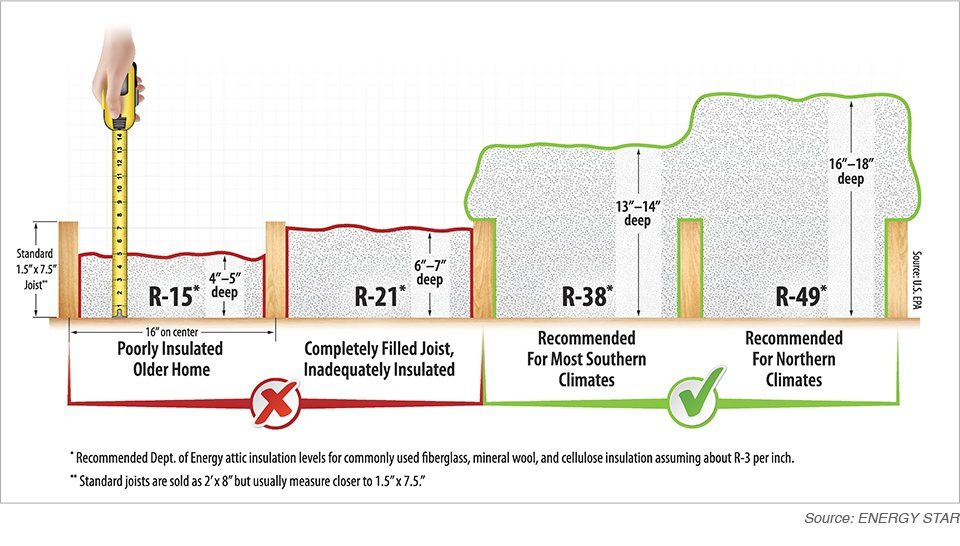
Assessing what you’ve got
| What you see: | What it probably is | Depth (inches) | Total Insulation R-value |
|---|---|---|---|
| Loose fibers | light-weight yellow, pink, or white | fiberglass | =2.5 x depth |
| dense gray or near white, may have black specs | rock wool | ____ | =2.8 x depth |
| small gray flat pieces or fibers (from newsprint) | cellulose | ____ | =3.7 x depth |
| Granules | light-weight | vermiculite or perlite | =2.7 x depth |
| Batts | light-weight yellow, pink, or white | fiberglass | =3.2 x depth |
How much insulation should you install?
The amount of insulation recommended for your home will vary depending on a number of factors:
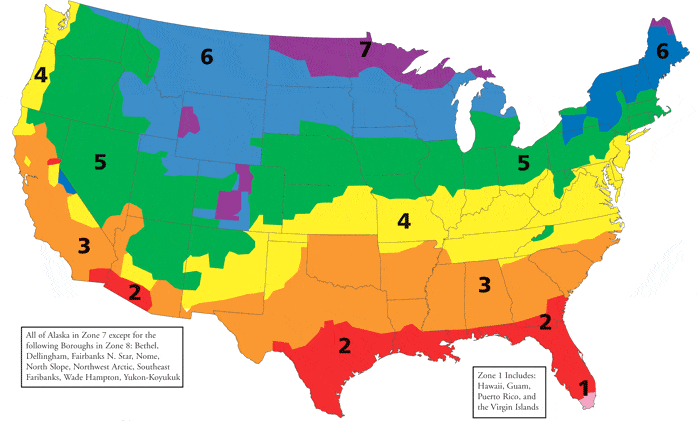
Where you live—Different climates require different insulation R-values. You will need a higher R-value of insulation if you live in the Northeast than if you live in Southern California.
Your home’s age—If your home is more than 10 year old, you likely need more insulation. There are many ways to retrofit a home with fiberglass and mineral wool insulation.
Recommended levels of insulation
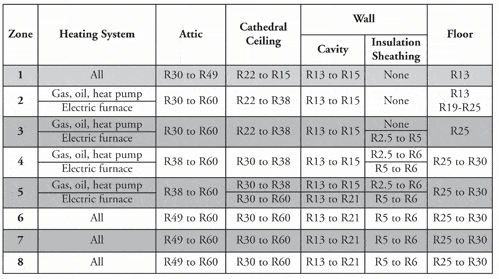
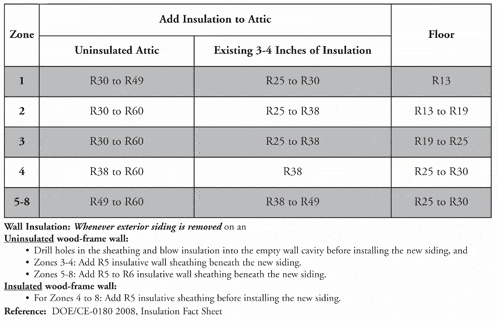
This map shows thermal recommended levels of insulation for various climate zones, based on recommendations from the U.S. Department of Energy (DOE) and the International Energy Conservation Code (IECC). The IECC is the model building code for the United States.
References:
–+1. NAIMA estimate based on Boston University study. “Under-insulated” here means when compared to the minimum prescriptive wall and ceiling insulation R-values found in the 2006 International Energy Conservation Code (IECC)
*Savings vary. Find out why in the seller’s fact sheet on R-values. Higher R-values mean greater insulating power.